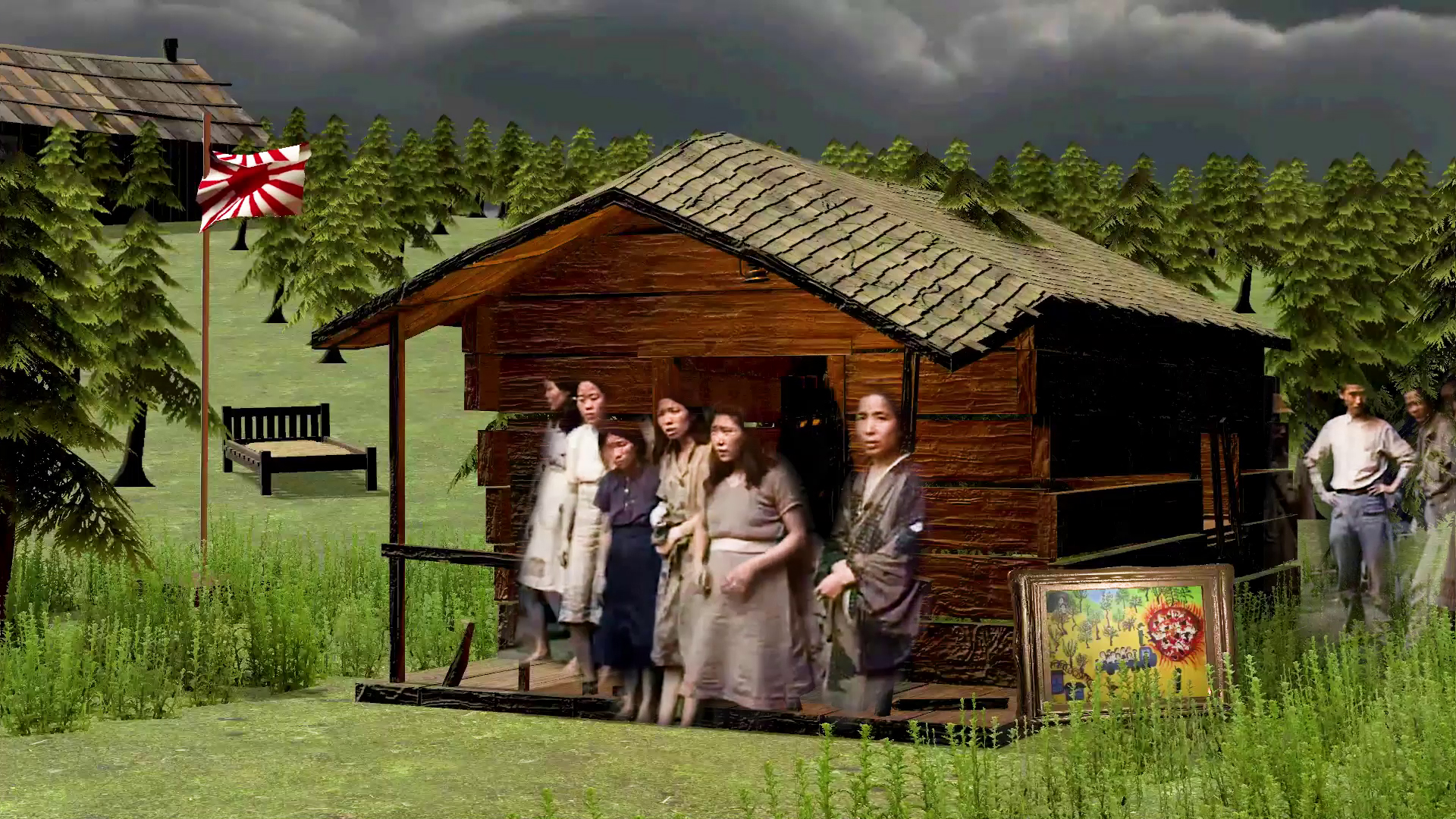


Still images from video


Text from exhibition
WHO CAUGHT THE YELLOW BUTTERFLY?, 2026,
sic! Elephanthouse, Luzern, Switzerland.
Whoever catches a butterfly captures a fleeting moment. Yet holding it captive also prevents it from flying. Between preservation and destruction, remembering and forgetting, lies a fragile moment. In Who Caught the Yellow Butterfly?, Kyungju Park (b. 1994, South Korea) explores how memories of past injustice can be preserved without repeating the violence they recount. And how we might give a voice to those who were silenced for decades.
The exhibition takes as its point of departure the history of women and girls who were subjected to sexual slavery by the Japanese military and its collaborators through deception, coercion and force during Japanese colonial rule and the Asia-Pacific War (1931–1945). They came from various occupied countries in Asia, many of them from Korea. They were referred to as so called „comfort women“, as though their purpose had been to offer consolation to soldiers. A euphemism that turns the perpetrators‘ perspective into the language of history, concealing the violence inflicted upon them. After the war, many survivors remained silent for fear of social ostracism and stigmatisation. It was not until 1991 that the Korean survivor Kim Hak-sun publicly broke her silence. Other women followed.
Individual life stories became a collective indictment; silence gave way to a political movement. Yet being able to speak does not necessarily mean being heard. The philosopher Miranda Fricker uses the concept of epistemic injustice to describe how people are denied recognition as credible bearers of knowledge because of social prejudices. Kristie Dotson further examines how testimony can be silenced through failures of listening and the refusal to acknowledge what is being said. The survivors were deprived not only of autonomy over their bodies but, for a long time, also of authority over their own histories.
The philosopher Jill Stauffer calls the experience of being abandoned by a world unwilling to listen after suffering violence ethical loneliness. Injustice continues wherever it is left unacknowledged. Wherever the voices of survivors remain unheard.
In the expansive video installation Papillons Jaunes (2023) , Park approaches this history through an unusual combination of documentary and fiction. On the right-hand side of the exhibition space, a vast digital landscape unfolds. Historical footage from the war gives way to a colourful, almost paradisiacal world. Images of Buddhist, Daoist, Catholic and Protestant commemorative rituals are combined with animations and computer-generated 3D landscapes. Documentary and digital imagery, past and present, reality and imagination overlap. Different religious traditions converge in a shared imaginary space dedicated to remembering the victims.
Park deliberately refrains from reenacting the violence inflicted upon them. Instead, she creates a virtual paradise in which the survivors might find peace. A form of consolation that reality denied them. What appears to be an idyllic world is therefore not an idealisation of the past but its counter-image. Fiction does not undo what happened; rather, it makes imaginable what was missing from reality: dignity, peace, recognition. The commemorative rituals do more than recall past events. Through repetition, recording and transmission, they sustain a relationship between the living and the dead. Remembering is not a state but an action.
A practice that must continually be renewed. The large-scale projection opens up a space into which viewers can immerse themselves. In the far-left corner, a second video work, Repetition (2026) , is presented on a small screen placed on the floor. A silvery, mercury-like computer-generated figure stands on a mirror-smooth expanse of water stretching to the horizon. It is a digital reconstruction of the bronze Peace Statue, which commemorates the victims of sexual slavery and whose installation, particularly in Berlin, has become the subject of fierce disputes over the politics of memory. Originally created by the artists Kim Seo-kyung and Kim Eun-sung, the statue depicts a young girl seated on a chair, facing forward, her hands clenched into fists. Beside her stands an empty chair. A place for those who are absent, but also for those willing to sit beside them and listen.
In Park‘s digital world, the bronze loses its material weight. Its surface becomes fluid; the monument turns into a reflective apparition. From the distance, graves marked with symbols of different religions glide towards us in central perspective, then recede and disappear into the horizon. Finally, the statue itself sinks beneath the water, only to reappear shortly afterwards. An endless cycle of appearing and disappearing, remembering and forgetting. The water is both mirror and abyss, a place of tranquillity and disappearance. What seemed solid and enduring loses its ground. The monument, intended to preserve memory, becomes transient itself.
Repetition is repetition, but not an identical return. The movement of the graves and the statue‘s sinking evoke a history that refuses to rest. The dead, whose voices are absent, and the living, who keep their memory alive. The graves bearing different religious symbols extend remembrance beyond national and denominational boundaries. At the same time, the statue‘s return points to the political struggles surrounding public recognition of these crimes. The repeated attempts to remove a monument from public space reveal how present the past remains.
Precisely through its digital transience, Park‘s Peace Statue seems to resist this erasure: it disappears, only to return. The spatial arrangement also alters our relationship to the image. While Papillons Jaunes envelops viewers through its expansive scale, the small screen demands a different kind of attention. We must move closer, lower our gaze, adjust our bodily posture. The images assert themselves not through their size but through their insistent return. Immersion in an imaginary world gives way to concentrated observation. Between the two works emerges a tension between abundance and reduction, movement and stillness, consolation and unease.
On the opposite short wall, four editions of a photobook rests on a shelf. Here, history is condensed into a single life. Park reconstructs the testimony of the Korean survivor Moon Ok-ju in diary form. The narrative follows her forced abduction, her sexual enslavement by the Japanese military, and her eventual return home, where social ostracism continued long after the war had ended. Page by page, a life story unfolds, no longer viewed from the distance of a completed past. The diary form brings events into a subjective present whose future remains uncertain. It is a story of fear and violence, but also of survival, relationships, decisions and the attempt to reclaim one‘s own life.
Unlike moving images, the book invites readers to determine their own pace. We may linger, turn back, revisit a page. Repetition becomes an action of our own. Towards the end, the narrative changes: Moon Ok-ju recounts how, after years of silence, she was finally able to make her story public. Her testimony becomes both a historical document and a demand addressed to those who come after her. Speaking alone does not overcome ethical loneliness; what is required is a world willing to listen and respond.
The three works thus unfold different forms of attention: immersion, looking closely, reading. From an expansive imaginary landscape, through the recurring image of a monument, to an intimate encounter with an individual testimony. It is no coincidence that Park tells this story in Switzerland. After several years in Europe, she became aware of how little is known here about the crimes committed by the Japanese military. Geographical distance creates a seemingly historical distance, making injustice appear foreign and safely confined to the past. Yet sexual violence in war and its social suppression are by no means confined to East Asia.
European societies, too, have long remained silent about their own histories of wartime sexual violence. Park does not equate these histories. Rather, beginning with the specific testimonies of Korean survivors, she asks how we might approach the experiences of others without appropriating them. How can we listen without speaking in place of those who testify? How can memory be transmitted across historical, cultural and geographical boundaries?
In his theses On the Concept of History, Walter Benjamin argues that remembering the past is not a matter of recognising it “the way it really was”, but of seizing hold of a memory at a moment of danger. History is not a closed collection of past events. It is remembered, forgotten, suppressed and politically contested in the present. The Peace Statue in Repetition seems to give material form to this endangered moment: it sinks and resurfaces, like a memory threatened with erasure yet continuing to exist. Its return is not a promise of redemption but an appeal not to look away.
What, then, can consolation mean in the face of an injustice that cannot be undone? Park‘s imaginary spaces can neither change history nor replace political justice. But they open up a space in which survivors‘ voices may continue to be heard. A space in which remembrance does not merely preserve the past but establishes a responsibility in the present. Whoever catches the yellow butterfly may preserve its memory. Yet whoever lets it fly gives it a future.
Text: Michel Rebosura
Papillons Jaunes (2023)
3 Channel video installation with sound, 4’37”, Loop, 5760 x 1080p.
이 비디오 설치 작업은 촬영한 영상을 기반으로 제작되었으며, 애니메이션과 3D 오브제는 게임엔진으로 제작되었습니다. 이 이야기는 2차 세계대전 중 일본이 한국을 강점하고 한국 여성들을 매춘으로 내몰아 성노예로 전락시킨 상황을 배경으로 합니다. 이 프로젝트는 피해 여성들의 증언과 아카이브 이미지, 그리고 그녀들의 고통을 위로하는 다양한 공식 의식을 담은 영상을 바탕으로 그들의 아픔에 공감하고 있습니다.
전쟁 상황을 묘사한 첫 번째 장면에 이어 조선시대 왕의 행차 음악이 나오며 두 번째 장면으로 이어집니다. 이는 여성 희생자들을 기리는 가상의 낙원입니다. 저는 피해자들을 위한 일종의 낙원을 만들어 다양한 종교 의식과 의례을 담은 영상을 아카이브했고, 종교와 상관없이 누군가를 기리는 행위가 이 낙원에 닿아 있다는 것을 보여주고 싶었습니다. 이 작품은 오랫동안 가려져 있던 희생자들의 명예 회복과 위로에 기여하고자 합니다.
(en)
This video installation is based on film footage, with animations and 3D objects created using a video game engine. The story takes place during the Second World War, when Japan invaded Korea and forced Korean women into prostitution and sexual slavery. The project is based on the testimonies of women victims, archive footage, and footage of various official ceremonies to sympathize with their suffering.
The first scene, depicting the conditions of war, is followed by the music of a procession by the king of the Jo-seon dynasty, which leads into the second scene. It's a virtual paradise honoring the women victims. I've archived footages of different religious ceremonies and rituals, and wanted to show that the act of honoring someone, regardless of religion, touches this paradise. This work aims to contribute to the restoration of honor and the comfort of victims who have long been overlooked.
(fr)
Cette installation vidéo est basée sur des séquences filmées, avec des animations et des objets en 3D créés avec un moteur
de jeu vidéo. L'histoire se déroule pendant la Seconde Guerre mondiale, lorsque le Japon a envahi la Corée et forcé les femmes coréennes à se prostituer et à devenir des esclaves sexuelles. Le projet est basé sur les témoignages des femmes victimes, des images d'archives et des séquences de diverses cérémonies officielles pour compatir à leurs souffrances.
La première scène, qui dépeint les conditions de la guerre, est suivie de la musique d'une procession du roi de la dynastie Jo-seon, qui mène à la deuxième scène. C'est un paradis virtuel pour l'honneur des femmes victimes. J'ai archivé des images de différentes cérémonies et rituels religieux, et j'ai voulu montrer que l'acte d'honorer quelqu'un, quelle que soit sa religion, touche ce paradis. Cette œuvre vise à contribuer à la restauration de l'honneur et au réconfort des victimes longtemps oubliées.


Installation view at HEAD-Genève, Switzerland.


Installation view of exhibition WHO CAUGHT THE YELLOW BUTTERFLY?, 2026, sic! Elephanthouse, Luzern, Switzerland.
Photo: Andri Stadler